Creating perfectly smooth custards and luscious puddings is a culinary art, and the secret often lies in having the right tools. If you’ve ever battled lumps or struggled to achieve that silky-smooth texture, you know the frustration. The whisk, an unassuming kitchen utensil, plays a pivotal role in transforming simple ingredients into decadent desserts. But with a dizzying array of whisks available, how do you choose the perfect one for your delicate custards and creamy puddings? Let’s dive into the world of whisks and uncover the ideal companions for your dessert-making adventures.
What is a Whisk and Why Do You Need One?
A whisk is a kitchen tool designed to blend ingredients smoothly and to incorporate air into mixtures. Typically comprising a handle and a series of wires or tines, whisks are essential for tasks ranging from aerating egg whites to emulsifying sauces. The history of the whisk traces back centuries, evolving from bundled twigs to the sophisticated stainless steel and silicone versions we use today. Their primary purpose remains constant: to achieve consistent textures that spoons or forks simply cannot.
The market offers several common whisk types, each with a unique design tailored for specific culinary applications. Among the most popular are the balloon whisk, known for its airy volume; the French whisk, prized for precision; and the flat whisk, designed for shallow vessels. Understanding these distinctions is key to elevating your dessert game.
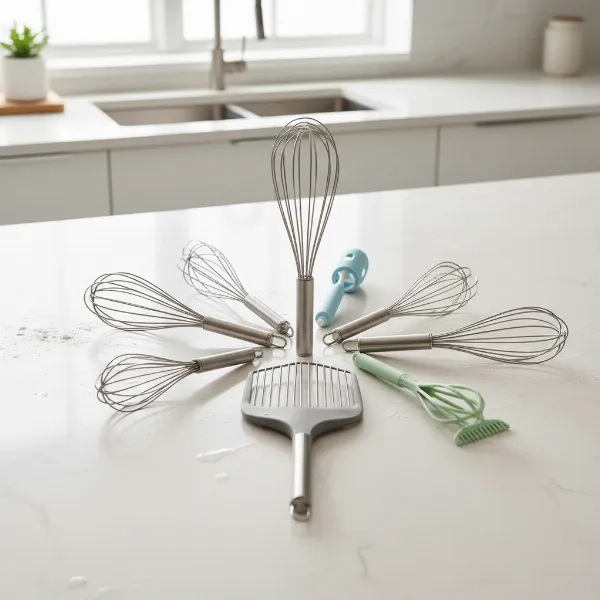 A collection of various whisks in a kitchen setting, highlighting different types and materials essential for culinary tasks.
Classifying Whisks by Purpose
Different whisk designs excel at different tasks. For custards and puddings, where a smooth, lump-free consistency is paramount, certain characteristics become vital.
Whisks for Beating Eggs and Cream
For tasks requiring significant aeration, such as whipping egg whites into meringue or transforming heavy cream into fluffy peaks, a whisk designed to incorporate maximum air is ideal.
- Balloon Whisk: This is perhaps the most recognizable whisk, characterized by its wide, rounded shape. Its large volume and numerous thin wires are excellent for quickly incorporating air into mixtures, making it a go-to for light batters and whipped cream. For custards, a balloon whisk can be effective for initial mixing and for keeping the custard in motion, especially in round bowls or sauciers, ensuring even cooking and a smooth consistency.
Whisks for Mixing Batters and Dry Ingredients
When combining dry ingredients or mixing thicker batters, a whisk that can break up clumps without getting bogged down is necessary.
- French Whisk: Slimmer and more tapered than a balloon whisk, the French whisk features more rigid, tightly packed wires. While it can incorporate air, its primary strength lies in its ability to thoroughly blend ingredients in smaller, deeper pots. This design is particularly adept at breaking up small lumps in custard bases or pudding mixes, ensuring a uniform, smooth consistency before cooking. Its narrow profile allows it to reach into the corners of saucepans more effectively.
Whisks for Making Sauces and Soups
For simmering sauces and delicate purees, a whisk that can continuously stir the bottom and sides of a pan is indispensable to prevent scorching and ensure smoothness.
- Flat Whisk: Also known as a roux whisk or sauce whisk, this tool features flat, elongated wires designed to lie flush against the bottom of shallow pans. It’s exceptional for mixing gravies, roux, and, critically, for constantly stirring custards and puddings as they cook on the stovetop. The flat design allows it to scrape up every bit from the pan’s surface, preventing lumps from forming and ensuring an impeccably smooth finish.
Specialty Whisks for Specific Applications
Beyond the main types, some specialized whisks cater to niche needs.
- Mini Whisk: These smaller versions of balloon or French whisks are perfect for small batches, such as whisking eggs in a single cup or mixing a small amount of sauce or vinaigrette. They are surprisingly effective for ensuring smoothness in small-volume custards or puddings destined for individual servings.
- Silicone Whisk: While not a unique shape, a silicone-coated whisk is a material variation that’s crucial for anyone using nonstick or enamel-coated pots and pans. It provides the same whisking action as its metal counterparts but protects delicate surfaces from scratches, making it a wise choice for cooking custards directly in nonstick saucepans.
Key Factors When Choosing a Whisk for Custards and Puddings
Selecting the best whisk goes beyond just type; several other factors contribute to its performance and your overall cooking experience.
Material (Stainless Steel, Silicone, Plastic)
The material of your whisk’s wires and handle significantly impacts its durability, hygiene, and suitability for different cookware.
- Stainless Steel: This is the most common and generally recommended material for whisk wires due to its durability, resistance to rust and corrosion, and non-reactivity with acidic ingredients. High-quality stainless steel maintains its shape even with vigorous whisking.
- Silicone: As mentioned, silicone-coated wires are a must-have for nonstick or enameled cookware. They prevent scratching while offering excellent flexibility. Ensure the silicone is high-heat resistant.
- Plastic: While inexpensive, plastic whisks are generally less durable and less effective at breaking up lumps compared to metal or silicone-coated options. They may also stain or retain odors over time.
Size and Shape
The size and shape of your whisk should match the size and depth of your cooking vessels.
- Smaller Whisks (8-10 inches): Ideal for smaller saucepans, mixing individual servings, or working in tight spaces. A French whisk or a mini whisk in this size range would be perfect for delicate custards.
- Medium Whisks (10-12 inches): A versatile size suitable for most standard mixing bowls and medium-sized pots. A balloon whisk of this size is a great all-rounder for general custard and pudding preparation.
- Larger Whisks (12+ inches): Best for large batches in big mixing bowls, though less commonly used for custards and puddings which typically require more precise, smaller movements.
- Wire Spacing: For custards and puddings, you want wires that are dense enough to break up lumps but not so dense that they clog with the mixture. French whisks often hit this sweet spot.
Handle (Comfort, Grip, Anti-Slip)
A comfortable and secure grip is paramount, especially during extended whisking over heat.
- Ergonomic Design: Look for handles that fit naturally in your hand, reducing fatigue.
- Material: Handles can be stainless steel, silicone, or a combination. Silicone-wrapped or textured handles offer a better anti-slip grip, particularly when hands are wet or greasy. Avoid overly long or heavy metal handles that might make the whisk top-heavy and prone to tipping out of a bowl.
Durability and Ease of Cleaning
A good whisk should withstand frequent use and be easy to maintain.
- Construction: Wires should be securely attached to the handle, without flimsy connections that could bend or break.
- Dishwasher Safe: Many stainless steel and silicone whisks are dishwasher safe, making cleanup a breeze. Always check manufacturer instructions. For whisks with wooden handles (like some Danish dough whisks, though less relevant for custards), hand washing is usually recommended.
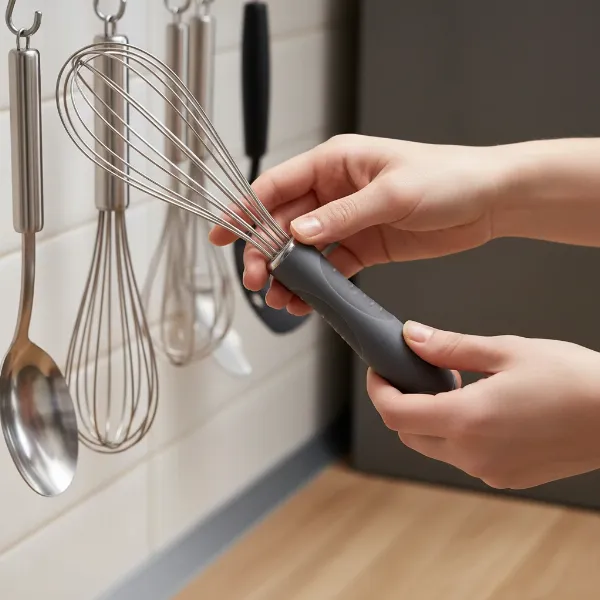 A person thoughtfully selecting a whisk from a rack, demonstrating key factors like handle comfort and whisk type for cooking.
Comparing Popular Whisk Types for Custards and Puddings
Let’s break down the primary contenders for making perfectly smooth desserts.
| Whisk Type | Key Features | Best For | Pros | Cons |
|---|---|---|---|---|
| Balloon Whisk | Wide, rounded shape; flexible, widely-spaced wires | Aerating, general mixing, keeping custards in motion in bowls | Versatile, good for incorporating air, easy to clean | Less effective in tight corners, wires can be too flexible for thick mixes |
| French Whisk | Narrower, tapered shape; stiffer, more tightly-packed wires | Blending sauces, custards, reaching pot corners, emulsifying | Excellent precision, great for smoothing lumps, durable | Can get clogged with very thick batters, harder to clean due to dense wires |
| Flat Whisk | Flat, elongated wires designed to hug pan bottom | Mixing in shallow pans, making roux/gravy, continuous stirring | Reaches pan corners effectively, prevents scorching/lumps | Not ideal for aeration, less versatile for deep bowls |
| Silicone Whisk | Wires coated in silicone (can be balloon, French, or flat style) | Nonstick cookware, delicate stirring, quiet whisking | Protects nonstick surfaces, heat resistant, easy to clean | May be less rigid than stainless steel, not ideal for very heavy mixtures |
Top Whisks for Making Custards and Puddings
Based on their design, performance, and user reviews, here are some top whisks that excel in creating lump-free, silky-smooth custards and puddings.
| Whisk | Pros | Cons | Price Range |
|---|---|---|---|
| GIR Ultimate Whisk (Balloon) | Excellent for keeping custards in motion, versatile, durable, comfortable handle | Not ideal for tight corners or very thick batters | Mid-High |
| OXO Good Grips 11-Inch Balloon Whisk | Comfortable teardrop handle, durable, good for general mixing & aeration | Similar to GIR, less precise than French whisks for corners | Mid |
| Hestan Provisions Stainless Steel French Whisk | Precise blending, reaches pot corners, high-quality construction | Higher price point, denser wires can be harder to clean with sticky mixtures | High |
| OXO Good Grips Flat Whisk | Excellent for shallow pans, scraping bottoms, preventing lumps | Limited use beyond shallow pans/sauces | Low-Mid |
| Kuhn Rikon Silicone Rainbow Whisk | Nonstick safe, good for delicate work, easy to clean | Wires can be less rigid than metal for heavy stirring | Low-Mid |
Buying Guide: How to Choose Your Perfect Whisk
Making the right choice involves considering your specific needs and cooking style.
-
Determine Your Primary Use: Are you mostly making custards in saucepans over heat, or light puddings in mixing bowls?
- For saucepans and precision blending, a French whisk or a flat whisk is highly recommended.
- For mixing bowls and general custard/pudding bases, a balloon whisk is a versatile choice.
- If you frequently use nonstick cookware, prioritize a silicone whisk (in French, balloon, or flat style).
-
Consider Material and Durability: Stainless steel is the gold standard for longevity. If nonstick safety is a concern, opt for silicone. Ensure the whisk feels sturdy and well-constructed.
-
Evaluate Handle Comfort: You’ll be whisking for several minutes, sometimes over heat. A comfortable, non-slip handle is crucial to prevent hand fatigue and ensure control.
-
Match Size to Cookware: A 10-inch whisk is a good starting point for most home cooks. A smaller 8-inch French whisk might be better for small saucepans, while a 12-inch balloon whisk suits larger mixing bowls.
-
Read Reviews: Pay attention to what other users say about a whisk’s performance with custards and puddings specifically. Look for comments on smoothness, ease of cleaning, and durability.
-
Budget: Whisks are generally affordable. While higher-end models offer superior construction and comfort, excellent options exist at every price point.
Tips for Using and Caring for Your Whisk
Even the best whisk needs to be used and cared for properly to ensure perfect results and a long lifespan.
How to Use Your Whisk Effectively
- Continuous Motion: For custards and puddings, constant stirring is key to preventing lumps and ensuring even thickening. Keep the whisk moving in a figure-eight or circular motion, reaching all parts of the pot or bowl.
- Reach the Corners: Especially when cooking over heat, ingredients can stick and scorch in the corners. Use a whisk whose shape allows it to scrape the bottom edges effectively—a French whisk for deeper pots, a flat whisk for shallow pans.
- Avoid Over-Aeration: While some aeration is fine, vigorously incorporating too much air into custards can lead to a frothy or bubbly texture, which is generally undesirable for a smooth finish. Focus on blending and smoothing rather than whipping.
- Temperature Control: When making custards, whisk continuously over moderate heat. If the mixture starts to curdle or clump, immediately remove it from heat while continuing to whisk vigorously to smooth it out.
Cleaning and Storage
- Immediate Rinse: Rinse your whisk immediately after use to prevent ingredients from drying and sticking to the wires. Warm, soapy water and a quick whisking motion often suffice.
- Deep Cleaning: For more stubborn residue, use a brush or sponge. Many stainless steel and silicone whisks are dishwasher safe, but always confirm with the manufacturer.
- Storage: Store whisks in a utensil crock or hang them to prevent the wires from getting bent or tangled, which can affect their performance.
Common Whisking Mistakes and How to Fix Them
- Lumps in Custard/Pudding: This often occurs from insufficient stirring or uneven heat. Whisk continuously, ensuring you reach the bottom and corners of the pan. If lumps form, try straining the mixture through a fine-mesh sieve or using an immersion blender for a few seconds.
- Scratched Nonstick Pans: Using a metal whisk on nonstick surfaces is a common culprit. Switch to a silicone-coated whisk to protect your cookware.
- Whisk Wires Bending: This typically indicates a low-quality whisk or using too much force on a delicate whisk. Invest in a whisk with sturdy stainless steel wires.
> “The secret to a truly exceptional custard isn’t just the recipe; it’s the continuous, mindful motion of the whisk, coaxing every ingredient into a silken embrace.” – Chef Elena Rodriguez, Culinary Arts Instructor
Conclusion
Achieving beautifully smooth custards and puddings is entirely within your reach, and the right whisk is an indispensable ally in this pursuit. Whether you opt for the precision of a French whisk, the corner-reaching capability of a flat whisk, or the versatility of a balloon whisk (especially one with silicone protection for nonstick pans), selecting a well-made tool tailored to your specific needs will dramatically improve your results. Invest in quality, understand its purpose, and master the art of whisking, and you’ll be delighting in flawless, lump-free desserts every time. What will be the first perfectly smooth dessert you create with your ideal whisk?
Frequently Asked Questions
Which whisk is best for preventing lumps in custard?
For preventing lumps in custard, both a French whisk and a flat whisk are highly effective. A French whisk’s narrow shape and dense wires allow it to reach into the corners of a saucepan, ensuring thorough blending, while a flat whisk excels at scraping the entire bottom surface of shallow pans, preventing any mixture from sticking and forming lumps.
Can I use a balloon whisk for puddings?
Yes, a balloon whisk can be used effectively for puddings, especially during the initial mixing of ingredients and for keeping the pudding in motion in a bowl or saucier. Its wide, rounded shape helps to blend ingredients and maintain a smooth consistency, though a French or flat whisk might offer more precision for scraping pan corners when cooking over heat.
Is a silicone whisk as effective as a metal one for custards?
A silicone whisk can be just as effective as a metal one for custards, provided it has sturdy, high-quality wires. Its primary advantage is protecting nonstick or enameled cookware from scratches. While some cheaper silicone whisks might be too flexible for very thick mixtures, well-designed models offer excellent performance while preserving your pans.
What size whisk is best for most dessert recipes?
A 10-inch whisk is generally considered the most versatile size for most dessert recipes, including custards and puddings. It offers a good balance between maneuverability for smaller batches and sufficient reach for standard mixing bowls and saucepans.